DEPARTMENTS

Mostrando entradas con la etiqueta Social Sciences. Mostrar todas las entradas

lunes, 16 de noviembre de 2026

Prehistory in the Iberian Peninsula: Our Classroom Museum

Our 1st ESO students have transformed their classroom into a Prehistory Museum! Their handmade replicas and archaeological displays take visitors on a journey through the Palaeolithic, Neolithic and Metal Ages in the Iberian Peninsula.An impressive scale model of a prehistoric collective tomb from Los Millares (Almería). Through this reconstruction, students explored burial practices, beliefs and the importance of funerary monuments in Copper Age communities.


Our 1st ESO students have travelled thousands of years back in time to discover what life was like in the Iberian Peninsula during Prehistory!

Working in teams, they have transformed their classroom into an amazing Prehistory Museum, exploring three major periods: the Palaeolithic, Neolithic and Metal Ages.

Each team was responsible for researching a real archaeological object, monument or prehistoric site from the Iberian Peninsula. They investigated its origins, historical period, materials, purpose and significance, as well as the lifestyles, beliefs and traditions of the communities that created and used it.

After completing their research, students became prehistoric artists, archaeologists and museum curators. Using different materials and creative techniques, they produced detailed replicas and scale models of their chosen artefacts and monuments.

Just like professional museum curators, they also prepared museum information cards, describing each exhibit, explaining its historical context and highlighting what it reveals about the lives of prehistoric communities.

The final stage of the project involved bringing all their creations together to build a classroom museum, where visitors could explore the evolution of human societies, from the first hunter-gatherers to the farming communities of the Neolithic and the metalworking cultures of the Bronze and Iron Ages.

Through this hands-on project, students have not only developed their historical knowledge but also strengthened their research, teamwork, creativity and communication skills.

Most importantly, they have discovered that archaeology is much more than studying ancient objects: every artefact tells a story about the people who made it, used it and left it behind.

Congratulations to our young archaeologists and museum curators for bringing the Prehistory of the Iberian Peninsula to life!


martes, 18 de febrero de 2025

1º ESO - Ancient Greece

 Ancient Greece civilisation - 1º ESO

The students of 1st ESO have made some posters about Ancient Greece. The class has been divided into groups and each group has imagined that they are a team of tour guides who are organizing trips to Greece. They have researched information about different aspects of this culture such as society, economy, sculpture, architecture, mythology or education and have made posters on cardboard to advertise their tours. They have searched for information, worked in teams and improved their oral expression when defending their projects in front of the class.


Medieval cities


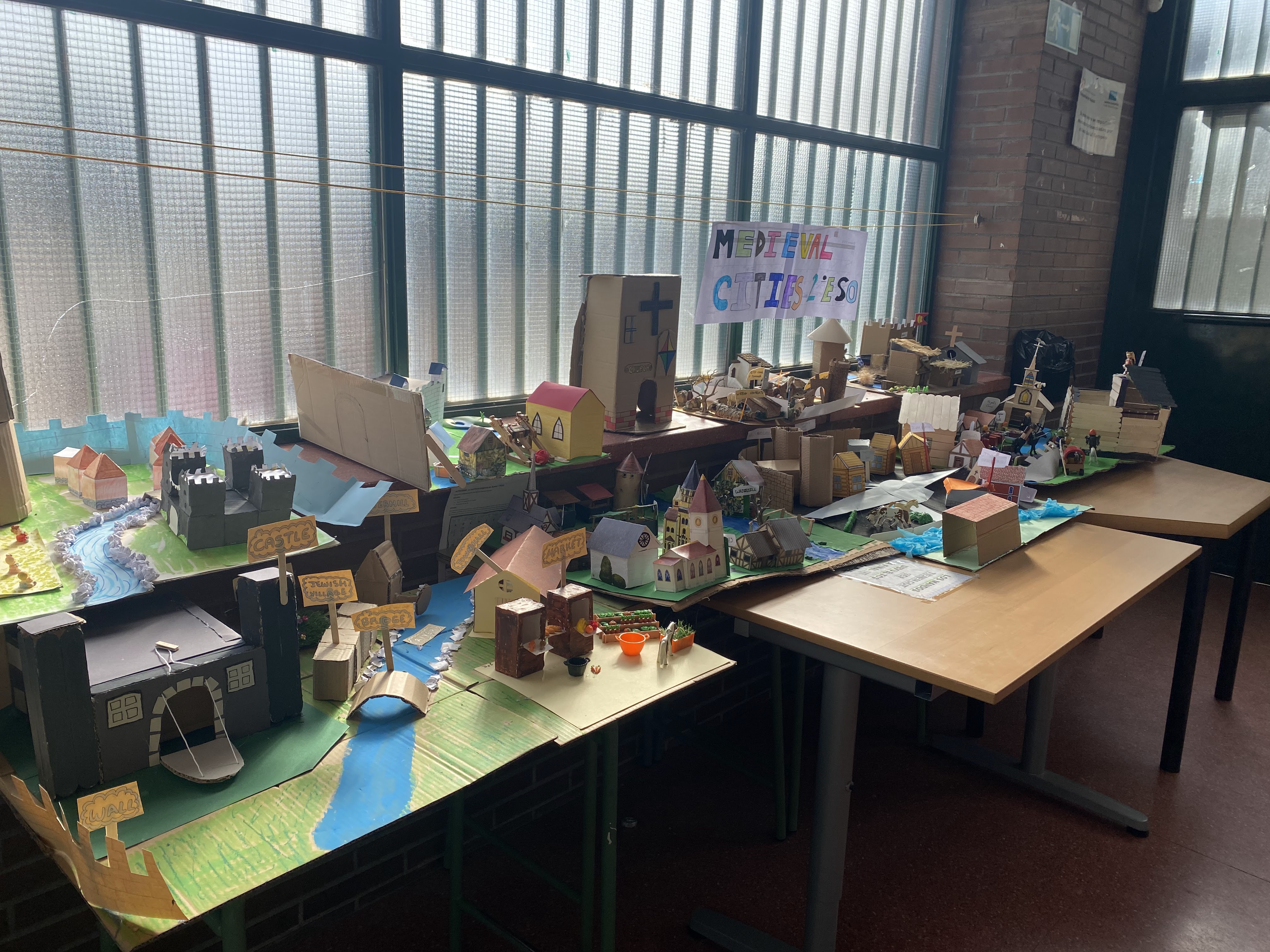
MEDIEVAL CITIES - 2º ESO (Geography and History)

The students of 2nd ESO D and E have elaborated by groups models of medieval cities from the High and Late Middle Ages. With this activity they have worked on the parts of the medieval city and the daily life of the different social groups that lived in it. The model has been elaborated during class time and then they have exposed their work to their classmates. The aim was to reinforce their capacity for research, teamwork and oral expression.


lunes, 9 de diciembre de 2024

MESOPOTAMIAN AND EGYPTIAN MYTHOLOGY


Our 1st-year ESO students recently completed an activity on ancient Egyptian and Mesopotamian gods. Each student was assigned a different deity, and they researched a myth associated with their god, as well as its influence on the daily lives of people at that time. To gather this information, they used the internet, learning to differentiate between reliable and unreliable websites. This activity not only enriched their knowledge of ancient civilizations but also developed their research skills and critical thinking when evaluating online sources.


In another activity, our 1st-year ESO students had the opportunity to experience writing like the ancient Sumerians, using clay tablets to simulate cuneiform script. This activity allowed them to understand firsthand the challenges and skills required to write in ancient times, helping them appreciate the value of early writing systems and their evolution. Additionally, they developed creativity and coordination as they tried to replicate cuneiform characters, gaining a deeper understanding of the role of writing in communication and the preservation of history.


martes, 31 de enero de 2023

Mª Jesús Pérez Díaz

 SIMPLY THE BEST, CALATALIFA HELPS!

This year, many of the projects our Section students are doing in all the subjects we teach in English revolve around a common topic we called: "Simply the Best, Calatalifa Helps!" 

The aim of this common theme is to make our students feel proud of themselves and our school when they help other students or people 💗.

We created the following Projects Landscape Poster to show everybody all the projects we will be doing from January to May in different years and subjects 👇:


domingo, 3 de abril de 2022

ART PROJECTS 4ºESO

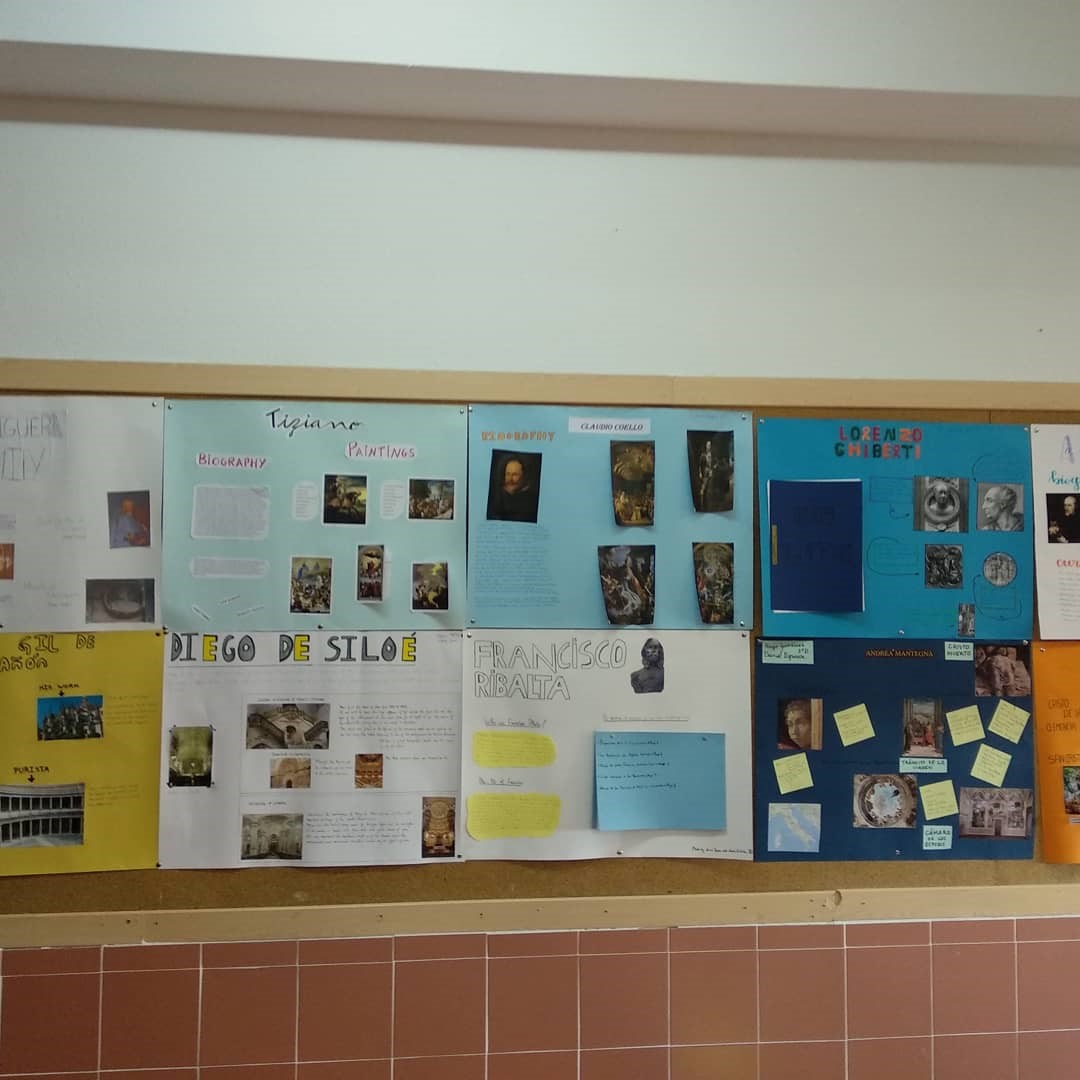
 The 4th ESO students have created a series of murals about artists from the 19th and 20th centuries, where they have worked on their biography, artistic style and main works. All this has been exposed in the hall of the secondary school.


miércoles, 28 de abril de 2021


On April 22nd we celebrated International Earth Day. The subjects of Geography and History and Arts, Crafts and Audiovisual Media proposed an interdisciplinary project to raise awareness on the importance of the 17 Sustainable Development Goals for the future of our planet, as approved by United Nations in the 2030 Agenda.

 The students were split into teams and carried out projects on each of the Sustainable Development Goals, covering topics such as green energy, waste generation or endangered wildlife habitats.

These are some of the resulting works, that include information on each topic and a poster created using the collage technique:


Great job everybody!


lunes, 28 de enero de 2019

TRIP TO ARQUEPINTO- 1º ESO

This past November, the bilingual and program students of 1º ESO were able to go on a field trip to Arqueopinto. During this excursion, the students were able to learn and see for themselves what an archaeological excavation looks like, as well as a receive a full explanation of the evolution of man from Australopithecus to Homo Sapiens; seeing their physical and cultural characteristics. It was very interesting to see a recreation of what they looked like, tools they used, how they hunted, and how they finally discovered fire.
They day after the trip, the same archaeologist who presented to us the day before came to Calatalifa to explain Paleolithic and Neolithic paintings. The students were able to see how the cavemen created paint from their surroundings, in the colours of red, yellow, and black. Once he explained what symbols cavemen used to tell their stories, he handed each student a brick tablet so they could then paint using the same symbols that were used in Prehistoric times.

The field trip and painting class were two great activities that reinforced what the students have been learning in class in a more real and dynamic way, plus, to have fun while doing so.


MURALS (RENAISSANCE-BOROQUE)- 3º ESO

The bilingual students of 3º ESO have created amazing murals about Renaissance and Baroque authors for their History class. They were divided into pairs and assigned a specific author and with little help from their professor, they had to research the author’s biography, characteristics, and their most famous works. In addition to completing the assignment’s curriculum, these type of projects allow the students to hone their group-work and interpersonal skills; because guiding students, but encouraging them to open up their minds and let their creativity show, one will see the abilities the students have and how they’re able to produce incredible work and showcase their talent. 


sábado, 28 de abril de 2018

BLACK DEATH IN THE MIDDLE AGES BY PAULA CARRIL (2 ESO C)


The Black Death is the name of a terrible bacterial disease that spread throughout Europe from 1348 to 1352. There was no cure for the disease and It was highly contagious.

The plague originated in Asia and travelled westward along the Silk Road, which was a trade route that went from China to Eastern Europe. Cities were the most affected because the population was dense and the disease was carried by fleas and rats. Although people had different points of view, for example, historians thought that black rats living on European merchantships caught the disease and eventually brought it to Europe. Other people believed that It was a punishment of God, some scientists thought it was a bacteria called Yersinia Pestis, the thing which marks the beginning of the disease. The rest realized that pockets of bad air released by earthquakes caused it and another amount of people blamed the Jews for bringing it to kill Christians.


It is hard to imagine how scary life was in the Middle Ages during the Black Death. It killed at least one third of the population in Europe, and probably more. Mortality was extremely high because the population at the time was badly nourished, and did not live in hygienic conditions.

In almost all cases the plague was contagious by transmission, which means that if an animal or person who had the Black Death touched you, you would get infected. The main symptoms were: high fever, shivering and swelling of the neck. If you presented this, it meant you were infected and you would surely die after a few days. To be completely sure, a health care provider diagnosed you by doing laboratory tests on blood or on fluid from a lymph node.


It was so destructive that It become known as the Black Death. Also because of how the skin turned dark at the late stages of the disease, but It was more likely called “Black” to reflect the dark and horrible time in history.

As you might expect, there was panic and many people were sure it was the end of the world. Their solution was to lock their doors and try to hide hide in their houses, but the plague expanded everywhere. In the face of despair, they burned down houses or even villages to try to stop this disaster.


Much of the infrastructure of Europe was gone in 1490. When the Black Death finally subsided, it took around 150 years for Europe to rebuild.


COMIC BY BLANCA TORRES AND ANA RODIL (2 ESO E)


jueves, 26 de abril de 2018

Greek Myths_ 1º ESO Myth of Prometheus

This is the script of the theatre work by Gino Cardarelli, Elisa Sánchez, Pablo Vega and Elsa Revilla. 1ºE
(Script, performance and scenography)


Narrator: Once upon a time....there was a Titan called Prometheus, benefactor of humanity. Zeus got so angry that he took the fire from the mortals.

Zeus: This will be your punishment!!! (Zeus takes the fire from the mortals)

Mortals: Noooo pleaseee!!!!!

Narrator: So Prometheus wanted to recover fire for the mortals.

Prometheus: I have to take the fire, the mortals need it!

Narrator: Prometheus went to the Mount Olympues to take the fire from Apolo´s carriage.

Prometheus: I have got the fire!!!

Narrator: And he gave it to the mortals. Zeus got so angry because of Prometheus´ taunt so he called Hephaestus and told him to make a clay woman called Pandora.

Hephaestus: (He makes Pandora)

Narrator: and Hermes gave Pandora to Epimeteo. Pandora had a box with all the evils in the world, but Epimeto fell in loved with her!

Epimeteo and Pandora: (walking and kisssing each other)

Narrator: Prometheus did not want Pandora and his brother to be together. Epimeteo after rethinking it, he decided to leave Pandora.

Epimeteo: Sorry Pandora, I can not be with you..

Narrator: Zeus was really angry because Pandora did not have waht he wanted. So he called Hephaestus for another plan.

Zeus: I need you Hephaestuus. You have to capture Prometheus and bring him to me!!

Narrator: Hephaestus went to capture Prometheus.

Hephaestus: Come here Prometheus!!!

Prometheus: Nooo! Let me go!!!

Narrator: Zeus had a really good plan, he wanted to tie Prometheus to a rock where an eagle came to eat his liver, but the liver would regenerate because he is inmortal.

Zeus: I will make him suffer !!! hahahahahahah

Narrator: One day Hercules saw the giant Eagle and he killed it, saving Prometheus.

Prometheus: You saved me form the eagle!!! Many thanks!!!!

Hercules: You are welcome, it has not been very difficult!

Narrator: Zeus, proud of his son, didn´t worry about Prometheus´ punishment, and he invited him to the Olimpo, but he would have to carry the rock where he wad tied.