DEPARTMENTS

martes, 11 de marzo de 2025

                                                                        4th ESO

BIOLOGY AND GEOLOGY 
Coordinated with Amaya Rodríguez


How to create your own customized Guess Who board game


WHY DESIGN GAMES?
Science classes are spaces that challenge students to think and ask questions and to develop ideas and solutions through scientific play and problem solving.
Each of the hands-on exhibits is designed to give them the freedom to explore, investigate, create and discover – at their own pace and in their own way.
In this case, students can create their own games, test their own designs and make their own discoveries.

GUESS WHO: THE GAME
The traditional game was called Who's Who and basically consisted of guessing which character our rival had chosen by asking questions about their physique or appearance.


CASE STUDY: SCIENTISTS
Students customize the traditional Guess who game to enhance their lesson plans, creating their own with photos or drawings of the chosen scientists. They also provide some information about their life, their successes, their profession or some little-known detail about them.
Here’s a flavour of the games 4th ESO have worked on…


                                                                             4º ESO

BIOLOGY AND GEOLOGY 
Coordinated with Amaya Rodríguez

WHY DESIGN SCIENTIFIC POSTERS?

Posters are widely used in the academic community, and most conferences include poster presentations in their program.  Research posters summarize information or research concisely and attractively to help publicize it and generate discussion. 

The poster is usually a mixture of a brief text combined with tables, graphs, pictures, and other presentation formats. At a conference, the researcher stands by the poster display while other participants can come and view the presentation and interact with the author.

WHAT MAKES A GOOD POSTER?
  • Important information should be readable from about 10 feet away
  • Title is short and draws interest
  • Word count of about 300 to 800 words
  • Text is clear and to the point
  • Use of bullets, numbering, and headlines make it easy to read
  • Effective use of graphics, color and fonts
  • Consistent and clean layout
  • Includes acknowledgments, your name and institutional affiliation
 
WHAT SOFTWARE WILL WE USE TO MAKE THIS POSTER?

Canva

WHY CRISPR ?

Just like humans, bacteria can get sick. Some bacteria have a defense system called CRISPR/Cas9 that protects them from viral infections. Over the last few years, scientists have adapted this bacterial defense system to be used in the laboratory to alter the DNA of various organisms. This article will explain how CRISPR/Cas9 is used to edit genes and will provide examples of how this technology is useful. Experiments using CRISPR/Cas9 must be carried out ethically, that is, scientists must ensure that all research respects human rights and animal welfare and complies with the law.


Here is a sample of the posters 4th ESO have worked on…


1st ESO
BIOLOGY AND GEOLOGY 
Coordinated with Amaya Rodríguez


Students will create an infographic to share knowledge and data about the kingdoms.


Task

Infographics are an increasingly popular way of sharing information in newspapers, magazines, and online news sites. These visual representations of knowledge and information are designed to make complex ideas and large amounts of data easy to understand. There are many ways to create infographics. After exploring a variety of examples, you will create your own infographic poster that will help others better understand an issue or concept you are studying.

Questions

 Which infographic was the best? Why?

  • What made them interesting, content or design? Or both?
  • How did the use of fonts, color, graphics, and imagery contribute?
  • Did the design contribute to how you felt about the information?


Here is a sample of the posters 1st ESO have worked on...


Inclusive Days Project with Paralympic Athlete Sara Granado


As part of our commitment to fostering inclusion and raising awareness about the challenges faced by individuals with disabilities, we recently carried out an inspiring Inclusive Days Project. This initiative aimed to promote empathy, understanding, and solidarity through hands-on experiences and meaningful interactions.

A highlight of this project was the visit of Sara Granado, a distinguished Paralympic athlete, whose presence and testimony deeply enriched our activities. Her story of perseverance and success served as a powerful reminder of the strength of the human spirit and the importance of accessibility and inclusivity in all aspects of life.

Throughout the event, we engaged in a variety of inclusive activities designed to help participants step into the shoes of individuals with disabilities. These experiences allowed us to grasp firsthand the challenges they face daily, fostering a sense of awareness, sensitivity, and respect. By navigating obstacles, participating in adaptive sports, and reflecting on the importance of an inclusive society, we gained invaluable insights that will stay with us beyond this initiative.

The Inclusive Days Project was more than just an event—it was a transformative experience that reinforced the importance of breaking barriers, celebrating diversity, and ensuring that everyone, regardless of ability, has the opportunity to thrive.

We extend our heartfelt gratitude to Sara Granado for her inspiring visit and to all participants who embraced this opportunity to learn, grow, and contribute to a more inclusive world. This is just the beginning of our ongoing journey toward building a society where everyone belongs and is valued.


lunes, 3 de marzo de 2025

OUR JOURNEY AS GLOBAL SCHOLARS IN 2nd ESO - Sección

Exploring Global Perspectives and Sustainable Choices

At our secondary school, and through the 2024-25 GLOBAL SCHOLARS program, students have been engaging in exciting and meaningful projects as part of the CALATA-LIFE initiative. These projects have allowed them to connect with peers worldwide, reflect on their consumption habits, and investigate the sustainability of local systems. Here’s a glimpse into the incredible work they have done:

1. Connecting as Global Scholars

Our students have exchanged perspectives with peers from different cities and countries, including Barcelona, Madrid, New York City, Buffalo, Astana, Paris, and Mumbai. Through discussion posts, they have shared insights about their cultures, daily lives, and global concerns. Additionally, they created engaging videos to introduce their class, school, and city, offering a glimpse into their world and explaining what it means to be a Global Scholar. 📽️ 

2. Rethinking Consumption for a Sustainable Future

Students have analyzed their daily consumption habits, considering how their environment and culture shape their choices. They explored sustainable alternatives and discovered ways to make more eco-friendly decisions. As part of this project, they created a photojournal showcasing creative ways to apply the 5Rs: Refuse, Reduce, Reuse, Repair, and Recycle.

3. Investigating Local City Systems

Through research and collaboration, students have examined various city systems—such as food, water, clothing, electronics, transportation, waste disposal, and the internet. They identified sustainability challenges and proposed solutions to improve accessibility and environmental impact. Using digital tools, they designed a comprehensive guide to share their findings and recommendations.

Furthermore, they actively participated in discussions and debates with other Global Scholars, gaining new perspectives and refining their ideas. To conclude the project, they delivered oral presentations to share their knowledge with their classmates.

🖼️ 📘 Explore their photojournals and discover their sustainability guides here (2ºF):


Hecho con Padlet
These projects have been an inspiring journey of global connection, critical thinking, and sustainability awareness. Our students are not just learning—they are taking action to shape a more responsible and informed future. Stay tuned for more amazing initiatives from CALATA-LIFE!

martes, 18 de febrero de 2025

1º ESO - Ancient Greece

 Ancient Greece civilisation - 1º ESO

The students of 1st ESO have made some posters about Ancient Greece. The class has been divided into groups and each group has imagined that they are a team of tour guides who are organizing trips to Greece. They have researched information about different aspects of this culture such as society, economy, sculpture, architecture, mythology or education and have made posters on cardboard to advertise their tours. They have searched for information, worked in teams and improved their oral expression when defending their projects in front of the class.


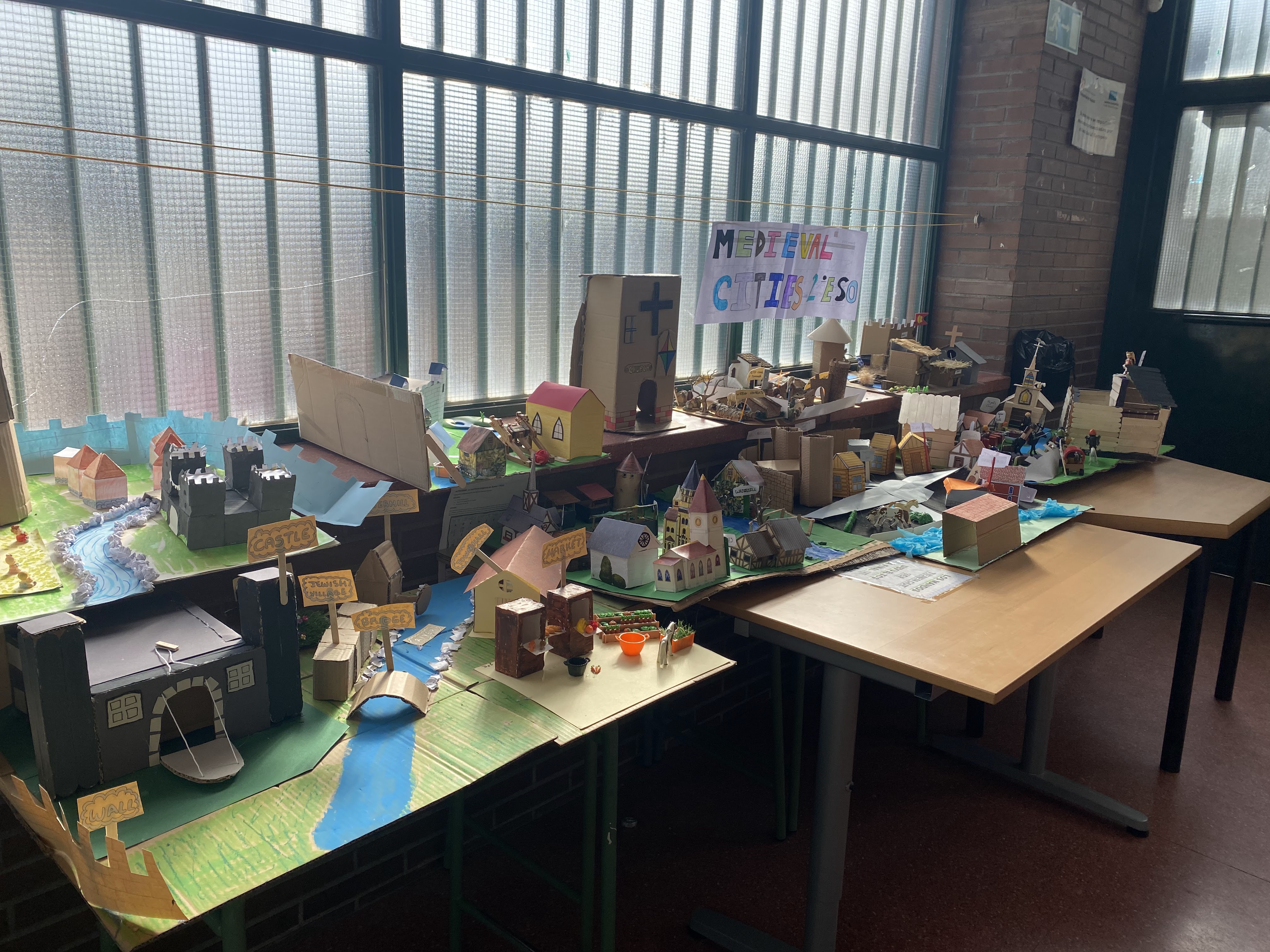
Medieval cities


MEDIEVAL CITIES - 2º ESO (Geography and History)

The students of 2nd ESO D and E have elaborated by groups models of medieval cities from the High and Late Middle Ages. With this activity they have worked on the parts of the medieval city and the daily life of the different social groups that lived in it. The model has been elaborated during class time and then they have exposed their work to their classmates. The aim was to reinforce their capacity for research, teamwork and oral expression.